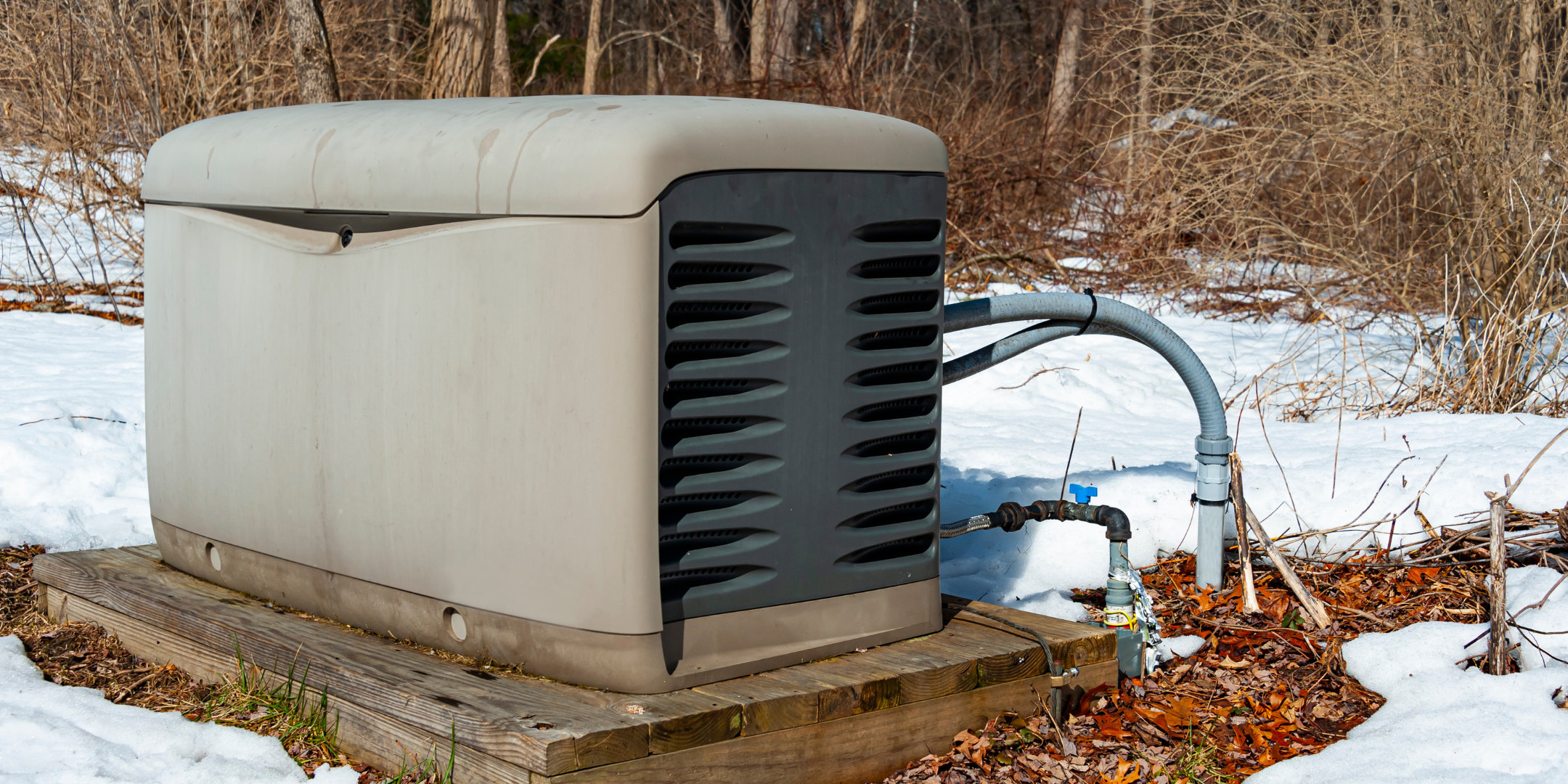
 A whole house generator typically costs about $10,000 to $20,000 installed, and Consumer Reports says the installation often costs more than the generator itself. National price guides run from about $6,000 for a simple job to $25,000 or more for a large unit on a hard site, which is why two quotes for the same house can differ by thousands of dollars.
If you searched "whole home generator cost" and landed on a page with one number, that number left something out. This guide breaks the total into the generator, transfer switch, pad, fuel connection, electrical work and permits, then adds the yearly cost to fuel and maintain it.
A&E Plumbing, Heating and Air installs and services whole-home generators across the Columbia River Gorge, the Gresham and Portland Metro area and southern Washington. A&E quotes each generator job after looking at your setup, so the dollar figures below are national ranges from named sources, not A&E prices. Every figure was checked on October 9, 2026, and each one names its source.
Quick Facts: Whole House Generator Cost at a Glance
Every number in this table comes from a named source, and the third column says which one.
| What you are pricing | National range | Source |
|---|---|---|
| Typical installed total, generator plus installation | About $10,000 to $20,000 | Reconciled from the sources in the next section |
| Range across published guides, installed | $6,000 to $11,000 typical at the low end, $10,000 to $25,000 at the high end | HomeGuide, December 2025, and ConsumerAffairs, September 2026 |
| Generator unit alone | $3,400 to nearly $7,000 | Consumer Reports, July 2026 |
| Installation alone | $5,000 to $10,000 or more | Consumer Reports, July 2026 |
| Professional maintenance, per year | $80 to $650 | HomeAdvisor, June 2026, and HomeGuide, December 2025 |
| Fuel for 24 hours at full load, 22 kW unit | About $113 to $182 on natural gas, about $250 on propane | Calculated from Generac and EIA figures, shown below |
| Rebate or tax credit for a gas or propane standby generator | None found | IRS and Pacific Power, covered below |
| A&E's general range on its generator page | $5,000 to $20,000 or more | A&E whole-house generator page |
Plan on $10,000 to $20,000, then let an itemized quote move that number up or down for your house.
How Much Does a Whole House Generator Cost Installed?
Most homeowners should plan on roughly $10,000 to $20,000 for the generator and installation together, but the published numbers disagree because each source counts different things.
- Consumer Reports (July 2026): whole-house models cost $3,400 to nearly $7,000 and installation runs about $5,000 to $10,000 or more. Added together, that is about $8,400 to $17,000 or more, which is a sum calculated for this article.
- HomeGuide (December 2025): $6,000 to $11,000 for a typical installed total, and $9,500 to $24,000 for units over 20 kW or long distances.
- ConsumerAffairs (September 2026): $10,000 to $25,000 for a standby generator.
- HomeAdvisor (June 2026): $5,000 to $25,000 for standby generators.
- A&E's generator page: $5,000 to $20,000 or more, depending on size, brand and installation requirements.
You may also see a lower average, such as $5,157, near the top of HomeAdvisor's cost guide. That page also lists portable generators at $500 to $2,000, so its headline average mixes small portable units with whole-house systems.
The part most price pages bury is the split. Consumer Reports says installation usually costs more than the generator itself, sometimes several times more, and that it may involve a plumbing or heating contractor for the gas line, a general contractor for the pad and an electrician for the panel connection. That is several jobs, not one.
The generator is often the smaller part of the bill, so a quote that shows only the unit price tells you very little.
What Does a Whole House Generator Cost by Size?
Bigger units cost more, but installation does not shrink much when the unit does, so a smaller generator saves less than you would expect. Consumer Reports says smaller units cost almost as much to install as larger ones.
| Size | Unit only, HomeAdvisor and Angi | Unit only, HomeGuide | Rough installed total (calculated) |
|---|---|---|---|
| 7 to 10 kW | $2,000 to $3,500 | $2,000 to $3,000 | $7,000 to $13,500 |
| 14 to 18 kW | $4,000 to $5,500 | $3,000 to $6,000 for 13 to 20 kW | $9,000 to $15,500 |
| 20 to 24 kW | $5,000 to $6,500 | $4,500 to $12,000 for 22 to 25 kW | $10,000 to $16,500 |
| 26 to 32 kW | $6,500 to $15,000 | $10,000 to $16,000 for 30 to 48 kW | $11,500 to $25,000 |
| 36 to 48 kW | $14,000 to $21,000 | $10,000 to $16,000 for 30 to 48 kW | Needs a site quote |
The last column adds the HomeAdvisor unit range to Consumer Reports' $5,000 to $10,000 installation range. It is a planning shortcut, not a quote. A short gas run and a simple permit can land you below it, as HomeGuide's $6,000 to $11,000 typical total shows, and a long pipe run or panel upgrade can push you past it.
Which size you need depends on the loads you want running during an outage, not on a rule of thumb about square footage. The whole house generator sizing guide on this site walks through that math. If you want central air on the generator, read Will Your Generator Run Your AC or Ruin It? first, because air conditioner start-up load is what often pushes a buyer into the next size up.
Choose the size from your loads first, then price that size, because buying small to save money can leave you with a unit that cannot do the job.
What Goes Into the Installed Price?
An installed price is a stack of separate jobs, and each one has its own range. The gaps between sources are real, so treat each row as a question to ask rather than a number to expect.

| Cost item | National range and source |
|---|---|
| Generator unit | $3,400 to nearly $7,000 for models Consumer Reports rates, with larger and premium units costing more |
| Installation labor | $1,500 to $5,000 at HomeAdvisor, $3,000 to $5,000 at HomeGuide |
| Automatic transfer switch, installed | $600 to $2,500 at HomeGuide, with about $1,450 as an average Consumer Reports cites from Angi |
| Concrete pad | $150 to $400 for a precast pad at HomeGuide, or about $1,000 for a small poured pad at $50 to $75 per square foot at HomeAdvisor |
| Natural gas line | $12 to $25 per foot in HomeGuide's cost table (its text says $15 to $50 or more), or $500 to $2,000 for a line or propane tank and lines at ConsumerAffairs |
| Propane tank installation | $400 to $1,800 at HomeGuide, $500 to $2,000 or more at ConsumerAffairs |
| Electrical wiring and panel work | Wiring $6 to $8 per foot at HomeGuide, a subpanel $500 to $2,000 at Angi, and a service upgrade from 100 to 200 amps $1,000 to $2,200 at ConsumerAffairs |
| Permits | $50 to $200 per permit at HomeAdvisor, $80 to $450 at HomeGuide, $80 to $500 at ConsumerAffairs |
| Add-ons | Wireless monitor $200 to $400 and smart load manager $150 to $300 at HomeAdvisor, cold-weather kit $130 to $500 at HomeGuide |
Dates for these figures: Consumer Reports, July 2026. HomeAdvisor, June 2026. HomeGuide, December 2025. ConsumerAffairs and Angi, September 2026. Two rows deserve a closer look. The concrete pad shows the widest gap, from a few hundred dollars for a precast slab to about a thousand for a poured one. The gas line depends on distance, and at HomeGuide's table rate of $12 to $25 per foot a 50-foot run is $600 to $1,250, a figure calculated for this article. HomeGuide's text puts the rate at $15 to $50 or more per foot, which would make the same run $750 to $2,500 or more.
Ask for each of these rows on your quote, and treat any row that is missing as a cost you have not met yet.
What Drives Your Total Up or Down?
Generator size and fuel type are the two biggest drivers, according to HomeAdvisor, and your site decides most of the rest. HomeAdvisor says models over 30 kW require liquid cooling, which adds a few thousand dollars. Distance from the pad to your gas meter and electrical panel is priced by the foot. An older or full panel may need a subpanel or service upgrade first. Permit and noise rules vary by city and county, and Consumer Reports says an electrician can help with those. Brand and tier matter too, since HomeGuide lists Kohler units at $2,700 to $16,000 and Cummins at $3,100 to $13,900, so ask which tier you are being quoted.
You control the size and the fuel choice, and the site controls the rest, so the fastest way to a firm number is to have someone look at your property.
What Does a Low Quote Leave Out?
A low quote often leaves out one of the big installation jobs, and a single lump-sum price gives you no way to see which one. Before you compare quotes, ask each contractor these questions and get the answers in writing.

- Is the automatic transfer switch in the price? HomeGuide puts installed switches at $600 to $2,500.
- Who pays for the gas line or propane tank, and how many feet of pipe are included?
- Is the pad included, and is it precast or poured?
- Are permits and inspections in the price, and who pulls them? HomeAdvisor says most homeowners need one permit for the electrical work and another for the fuel line or tank.
- Does the price cover any panel or service upgrade your house needs? ConsumerAffairs puts a 100 to 200 amp upgrade at $1,000 to $2,200.
- Will a licensed electrician do the connection? Pacific Power says permanent standby generators must be installed by a licensed electrician.
- Are startup, testing and the first service visit included? Generac's published warranty excludes installation, start-up and damage from improper installation.
- Are monitoring, load management and a cold-weather kit in the price or extra?
A quote that answers all eight is not always the cheapest, but it is the one you can compare.
Compare quotes line by line, because the lowest total is often the one with the most items missing.
What Does It Cost to Fuel and Maintain a Whole House Generator?
Professional maintenance runs roughly $80 to $650 a year depending on the source and the service, and fuel only costs you while the generator is running. Both belong in your budget before you sign.
Fuel for an outage
Generac publishes fuel use for its 22 kW Guardian air-cooled unit on its support page, and the page calls the figures approximate. At full load that unit burns up to 327 cubic feet of natural gas or 3.90 gallons of propane per hour, and at half load it burns 2.53 gallons of propane per hour. Multiplying those by two public price averages shows what a 24 hour outage could cost.
| Fuel and load | Burn rate | 24 hours | Price used | Estimated cost |
|---|---|---|---|---|
| Natural gas, full load | 327 cubic feet per hour | 7.85 thousand cubic feet | $14.41 per thousand cubic feet, Oregon residential average, February 2026, EIA | About $113 at the February price, about $182 at the July price of $23.23 |
| Propane, full load | 3.90 gallons per hour | 93.6 gallons | $2.668 per gallon, U.S. residential average, March 2026, EIA | About $250 |
| Propane, half load | 2.53 gallons per hour | 60.7 gallons | $2.668 per gallon, same source | About $162 |
These are rough ceilings. EIA computes its residential gas price by dividing revenue by gas sold, so it folds in delivery and other charges and may overstate what extra gas costs you, and its Oregon figure ran from $14.41 in February 2026 to $23.23 in July 2026. The propane price is a national average, so use your supplier's number. Most outages also do not run a generator flat out. Natural gas costs less per day in this math and needs no refills, while a propane tank holds a limited supply. The natural gas versus diesel generator comparison covers the fuel tradeoffs.
Maintenance
HomeAdvisor says to set aside $80 to $300 per year for professional service, and HomeGuide puts annual maintenance at $200 to $650. Consumer Reports says many standby units run themselves for a few minutes on a schedule and flag problems, but that does not replace a service visit, and Generac's warranty requires scheduled maintenance.
A&E's Whole-Home Generator Membership costs $20.75 a month, which adds up to $249 over 12 months. It includes one annual visit with an inspection plus air filter, oil, oil filter and spark plug replacement, priority scheduling and 10 percent off parts and labor. Repairs outside that visit are billed separately. The generator maintenance tips post lists what a good visit covers.
Budget about $250 a year for maintenance and a few hundred dollars of fuel for each long outage, and ask what your warranty requires.
What Does a Generator Warranty Cover?
Warranty terms differ by brand and model tier, so read the one for the exact unit you are quoted. Generac's published five-year limited warranty for air-cooled standby units covers years one and two on parts and labor, year three on parts, and years four and five on the engine short block and alternator parts only. It requires scheduled maintenance, and it excludes installation, start-up and damage from improper installation.
A&E's membership page says that if A&E installed your equipment, the membership extends its warranty coverage. Ask for the exact terms in writing before you rely on that.
A warranty is only as good as the installation and the maintenance record behind it, so keep both.
Is There a Rebate or Tax Credit for a Whole House Generator in 2026?
Not a broad one. No federal credit or utility rebate we could find pays toward a gas or propane standby generator, so do not build a rebate into your budget.
- Federal tax credit. The IRS residential clean energy credit covers solar, wind, geothermal, fuel cells and battery storage, and it says the credit is not available for property placed in service after December 31, 2025. A gas or propane standby generator is not on that list.
- Pacific Power in Oregon. If Pacific Power is your electric utility, its backup power rebate pays up to $1,000 to income-qualified customers who rely on electricity for medical equipment and up to $4,000 to licensed care facilities. Residential applicants must be enrolled in both the Medical Certificate and Low-Income Discount programs, and purchases must fall in 2026.
- The catch. The program says a product must be on its Qualified Product List. The list we read on October 9, 2026 holds portable power stations and battery generators. No permanent standby generator appears on it, so do not assume a whole house unit qualifies. Ask the program before you buy.
- Other utilities. No Portland General Electric or Washington utility generator rebate turned up in our search. Programs change, so ask your own utility.
Treat any ad or quote that promises a generator tax credit as out of date until it shows you the IRS rule.
Can You Finance a Whole House Generator?
A&E offers financing on approved credit, so ask about it when you request a generator quote. The A&E financing page lists a lender with 36-month terms and extended-term options that carry a recommended $3,000 deposit, plus promotional offers.
Financing spreads the cost out without lowering it, so compare the total cost of the loan and finance the itemized quote, not a lump sum.
What Are the Cheaper Options, and What Do They Give Up?
A portable generator with a transfer switch or interlock costs far less, and it gives up automatic start. Consumer Reports says large portable generators in its ratings that can power a whole house start as low as $800, against $3,400 to nearly $7,000 for whole-house models. Where code allows, the Consumer Reports buying guide says an electrician can install an interlock for about $50 to $150 for the kit plus $400 to $800 for labor, which is less than a transfer switch.
What you give up is automatic start, since you connect and start a portable unit yourself, and easy fuel handling, since you store and refill the fuel. Consumer Reports also says both portable and whole-house generators carry a carbon monoxide risk, so keep working CO detectors in your home. The portable versus standby generator guide compares the two, and Is a Whole-House Generator Worth It? weighs the cost against outage losses.
A portable setup is the cheaper path if you accept manual work, and a standby unit is the path if you want power with no one at home.
Does Living in the Gorge or Portland Metro Change the Cost?
No installed-cost data for the Gorge or Portland Metro turned up, so the ranges above are national. What changes locally is your fuel connection, your permit and the outage risk you are insuring against. Here is what could be verified.
- Wildfire shutoffs. Pacific Power's Public Safety Power Shutoff page says turning power off in areas with hazardous weather, such as extremely hot, dry and windy conditions, may be necessary. Its Hood River shutoff maps list Hood River Urban West, Hood River Urban South and Hood River/Wasco Rural areas, so check them if Pacific Power serves your address.
- Natural gas is not immune to outages. In December 2020 a car hit a regulator station in Hood River, and about 5,000 NW Natural customers in Hood River and White Salmon lost gas service, with restoration expected days later. A natural gas generator runs on that same supply. A propane tank keeps fuel on site, but only as much as the tank holds.
- Cold. NOAA's 1991 to 2020 normals show the Hood River Experiment Station averaging 8.0 days a year with a low at or below 20°F, against 1.3 days at Portland International Airport. HomeGuide lists cold-weather kits at $130 to $500, so ask whether your unit and site call for one.
- Permits. Fees and rules differ by city and county, so ask your installer which jurisdiction applies. A&E serves Oregon and Washington communities.
The local price differences come from your fuel run, your permit office and your site, so confirm those three before you trust any national number.
How Does A&E Quote a Whole House Generator?
A&E quotes each generator job after looking at your setup, and the quote is meant to cover the full scope of work: equipment, install and everything in between. A&E does not post a price list. Its generator page gives a general range of $5,000 to $20,000 or more, depending on size, brand and installation requirements, which fits inside the national ranges above.
Use the eight questions above when you get yours, and ask for the quote to show each cost item on its own line. You can read about what A&E installs and services on the whole-house generator services page.
Hold an A&E quote to the same eight questions as any other, and expect the full scope to be spelled out.
Whole House Generator Cost Questions Buyers Ask
How much does a whole house generator cost installed?
Plan on about $10,000 to $20,000 for the generator and installation together. Published guides range from about $6,000 for a simple job to $25,000 or more for a large unit on a hard site.
Do I need a permit to install a whole house generator?
Most homeowners need one permit for the electrical work and another for the fuel line or tank, according to HomeAdvisor, at roughly $50 to $200 each. Pacific Power says a permanent standby generator must be installed by a licensed electrician. Your city or county sets the real fee, so ask which permits are in the quote.
Does natural gas or propane cost less to run?
At full load, Generac's published figures for a 22 kW unit work out to about $113 to $182 a day on natural gas and about $250 a day on propane, using EIA's Oregon residential gas average for February 2026 ($14.41) and July 2026 ($23.23) and its March 2026 national propane average. Natural gas costs less per day and needs no refills, while a propane tank holds a limited supply. Your own rates will change those numbers.
Is there a tax credit or rebate for a whole house generator in 2026?
None that we could find pays toward a gas or propane standby generator. The federal residential clean energy credit covers solar, wind, geothermal, fuel cells and battery storage, and it ended for property placed in service after December 31, 2025. Pacific Power's Oregon backup power rebate pays up to $1,000 or $4,000 to qualifying customers and care facilities, but its qualified product list held portable power stations and batteries, so confirm with the program before you buy.
How much does generator maintenance cost each year?
HomeAdvisor says to set aside $80 to $300 per year for professional service, and HomeGuide puts annual maintenance at $200 to $650. A&E's Whole-Home Generator Membership is $20.75 a month, which adds up to $249 over 12 months, and includes one annual maintenance visit. Repairs outside that visit are billed separately.
Can I finance a whole house generator?
A&E offers financing on approved credit, and its financing page lists a lender with 36-month terms and extended-term options that carry a recommended $3,000 deposit. Ask whether a generator job qualifies when you request your quote. Compare the full cost of the loan, not only the monthly payment.
What Should You Do Before You Ask for Quotes?
A whole house generator costs about $10,000 to $20,000 installed for most homes, and the unit is often the smaller part of that. Three things move your number the most: the size you need, the distance of your fuel run and the condition of your electrical panel.
Two things remain unconfirmed: local installed-cost data for the Gorge and Portland Metro, and any rebate that covers a standby unit. The range is a starting point, and the itemized quote is the answer.
Start by listing what you want running and confirming the size with the sizing guide. Then find out whether a gas main runs to your street, and ask for an itemized quote using the eight questions above.
Still deciding whether a generator is worth that much money? Is a Whole-House Generator Worth It? covers the benefits, the drawbacks and when the cost pays off, so you can decide before you collect quotes.

See what A&E installs and services, then request a quote or schedule a service call. A&E serves the Columbia River Gorge, Gresham and Portland Metro, and southern Washington.
Sources checked October 9, 2026: Consumer Reports, HomeAdvisor, IRS, Pacific Power, EIA, Generac, NW Natural reporting and NOAA, linked above where they are cited. HomeGuide, ConsumerAffairs and Angi cost guides from 2025 and 2026 are quoted by name and date, without links.
Topics: